Author Ken Walker ◦
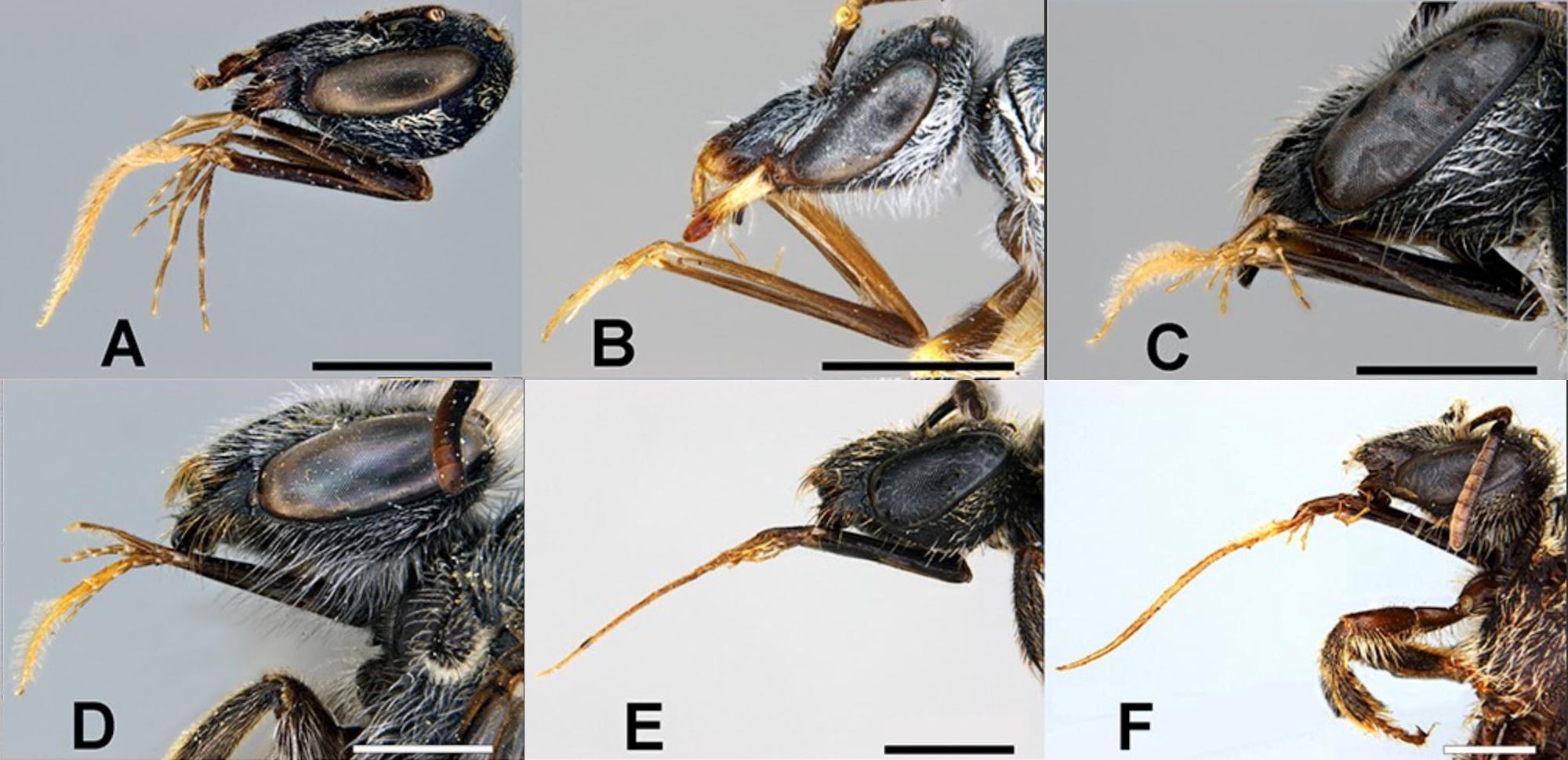
Here is something hopefully of interest. It’s an image plate I prepared for an upcoming paper. A new species of Lasioglossum I described has an elongate and hairy glossa (or tongue) so I decided to compare it with other Lasioglossum species also with an elongate glossa. Remember that all bees are divided into two groups: short or long tongued bees. In theory, the long tongue bees “only” visit flowers with a deep corolla where the hidden nectaries are protected while short tongue bees “only” visit flowers with a shallow floral cup or a short corolla. Nature makes the rules but then loves to break its own rules. Who says that a short tongued bee cannot extract nectar from a flower with a deep corolla? The results are both hilarious and remarkable.
Remember all bees in the image plate are short tongued bees. Here’s what they are.
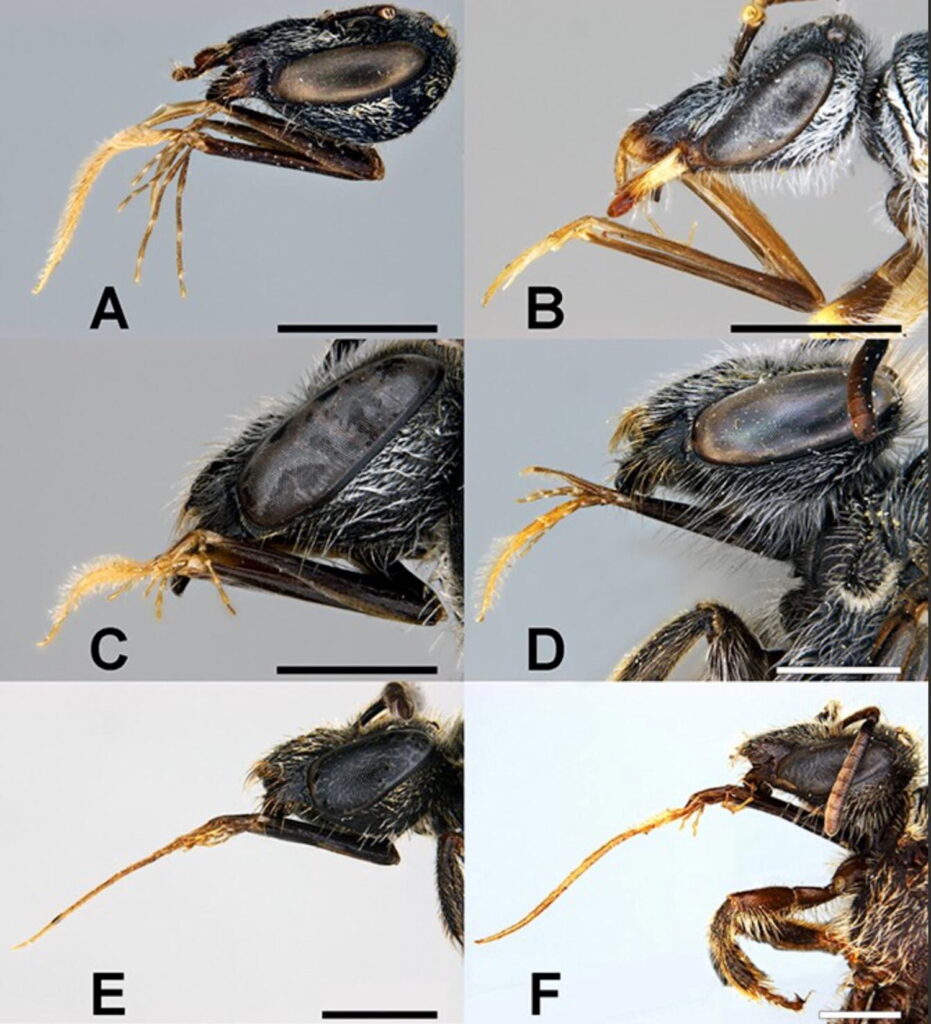
(A) Lasioglossum (Chilalictus) abrophilum from central Australia and without any floral records.
(B) Lasioglossum (Chilalictus) frankenia from the mound springs in the South Australian desert. As the name suggests, it feeds exclusively on the salt tolerant Frankenia flowers. Here the glossa is not elongated but rather the mouthparts (prementum and mentum) that support the glossa are elongated to push the glossa down into the deep tubular Frankenia flowers.
(C) The new species of Lasioglossum (Ctenonomia) I am describing but whose name is a secret until published. Occurs only in the NW of Western Australia and probably feeds exclusively on Brachychiton flowers.
(D) Lasioglossum (Glossalictus) etheridgei known only from the SW corner of Western Australia. Known only from nine female specimens and no floral records.
(E) Lasioglossum (Ipomalictus), now placed in Lasioglossum (Ctenonomia) from South Africa. Floral records unknown.
(F) Lasioglossum (Nesohalictus) halictoides, now placed in Ctenonomia, from the Philippines and visits only Ipomoea or Morning Glory flowers.
The scale bar in each image measures 1 mm. Hopefully you can see from the “no floral record” comments just how important it is to record the plant on which you collect or photograph a bee. Happy Pollinator Week.
Footnote & References
- A new species of Lasioglossum © Ken Walker